Jump to Section

EcoEducate promotes the following educational best practices:
HLPs are fundamental teaching strategies proven to improve student learning significantly. As mentioned above, examples include planning based on concrete objectives, effective classroom management, differentiated instruction, and facilitating learning around driving questions. While HLPs were originally conceptualized and applied in the U.S., research by organizations such as the Inter-American Development Bank (IDB) and the World Bank has demonstrated the effectiveness of HLPs in improving educational outcomes in Latin America.
Project-based learning (PBL) immerses students in real-world challenges, turning them into active problem-solvers. Instead of passively absorbing information, students tackle complex projects over an extended period, applying knowledge to create tangible outcomes. This approach encourages collaboration, critical thinking, interdisciplinary approaches, and creativity as students research, design, and present solutions. For example, they might conduct a comparative analysis of renewable energy technologies, develop a marketing plan for a new product, or create a documentary on climate change impacts. PBL transforms learning into a dynamic, hands-on experience, making education relevant and engaging while fostering essential skills for the future.
Place-based education immerses students in their local environment to connect learning with real-world contexts and community issues. It involves exploring local ecology, economy, and culture to make learning relevant and meaningful. Like PBL, PBE emphasizes active, hands-on experiences and problem-solving. However, while PBL focuses on student-driven projects that can address various topics, place-based education is rooted explicitly in the local community and environment, making the local context the central theme. For example, students might analyze their town’s local food system by mapping out the supply chain from local farms to markets, interviewing local producers and consumers, studying ecological issues related to farm production, and proposing strategies to promote sustainable economic growth in their community.
Strengthening teacher agency (autonomy in making instructional decisions) and metacognition (awareness and management of one’s own learning processes) are crucial for effective professional development. Teacher agency empowers educators to make informed decisions about their teaching practices, fostering a sense of ownership and initiative in their professional growth. It enables teachers to tailor strategies to their unique classroom contexts and needs. Metacognition helps teachers evaluate and refine their instructional methods. Together, these components promote continuous improvement by encouraging teachers to self-assess, adapt, and innovate.
EcoEducate’s monitoring and evaluation strategy addresses critical research questions, such as: “How has the program impacted teacher instructional skills?” “What improvements in student achievements can be attributed to the program?” “How have teachers’ and students’ understanding of environmental issues (environmental literacy) changed as a result of the program?” and “How sustainable is the program given local resources?”
We employ a combination of methods: classroom observations to measure changes in teacher practice and pre- and post- workshop surveys to measure changes in teacher knowledge and attitudes. Additionally, interviews with teachers, program facilitators, and students provide qualitative insights, while feedback from local stakeholders helps ensure the program’s relevance and acceptability. When available, we use student performance data from education authorities to gauge changes in student performance/outcomes. We will adapt aspects of the North American Association for Environmental Education’s (NAAEE) Framework for Environmental Literacy to measure changes in student and teacher environmental literacy.
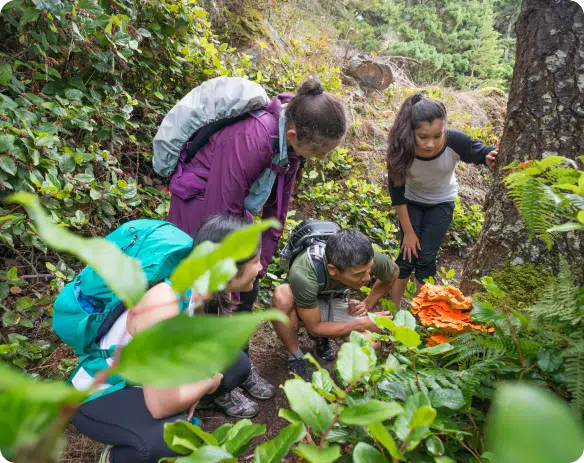
A visit to a middle school reveals numerous small groups of students in the schoolyard with notebooks, tape measures, measuring cups, and other equipment in hand, conducting an experiment on the effectiveness of different natural materials in filtering water. The students are using materials such as sand, coconut fiber, and crushed shells to build simple water filtration systems and test how well each set-up removes impurities from water collected from local sources. They are documenting their results to understand the role of natural materials in maintaining water quality on their island.
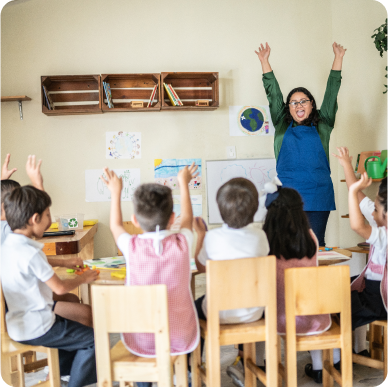
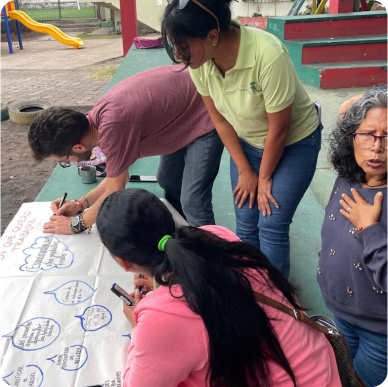
Teachers act as facilitators of learning, guiding students through interactive activities and group discussions and investing extra time with students struggling with concepts. Inquiry-based learning drives the approach, where students explore questions and problems through research and investigation, enhancing critical thinking.
© Diego Bermeo
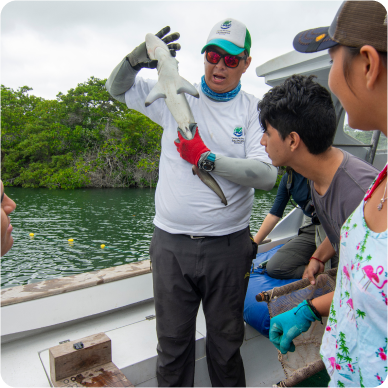
Groups of students, accompanied by their teachers, continue to learn core subjects – math, science, language arts, social studies, and even English language – but they do so while applying these subjects to real-life opportunities and challenges.
One group is strengthening their biology skills while working with scientists to study the unique marine life around their islands, deepening their understanding of conservation through hands-on research and fieldwork. Others are learning language arts and social studies as they research various aspects of their island’s history, interviewing community leaders and those who have lived there the longest, to eventually compile their findings in a short documentary video they will share with the community. Another group applies math and physics while working with experts to design and test small-scale renewable energy projects, like solar-powered water pumps or wind turbines, to reduce reliance on imported fossil fuels and promote sustainable energy use. In all these cases, classroom instruction before, during, and following these extended field-based experiences deepens student learning.
They embrace intensive, research-based teacher professional development that improves their ability to facilitate learning inside and outside the classroom. By fostering learning that integrates local challenges and resources, educators help students learn by doing and develop a deeper connection to their community. This educational approach not only strengthens students’ skills but also promotes sustainable practices and local innovation, ultimately driving economic and social development and ensuring a more resilient future for the community.
© Diego Bermeo