By Amelia Farber, EcoEducate Board of Advisors
As an outsider who’s visited the Galapagos Islands several times and worked with local schools, teachers, and community leaders on environmental education and sustainability projects, I’ve noticed a strong and inspiring theme running through all my observations and conversations. On these islands that inspired Charles Darwin’s theory of evolution, there’s a shared sense of purpose in advancing education, especially around sustainability. Everyone—students, teachers, parents, community members, National Park staff, and NGO leaders—seems to be working intentionally towards the ongoing evolution of education on the islands.
But, while international researchers have long conducted studies on the unique flora and fauna of the Galapagos, the evolution of education on the islands, particularly Education for Sustainability (EFS), has garnered less attention. EFS encourages reflection and action on sustainability issues and envisions more informed, democratic futures. Various international, national, and local organizations like UNESCO, the Ecuadorian Ministry of Education, the Galapagos National Park, the Fundación Scalesia, Fundación Ecos, and Galapagos Conservancy have supported EFS initiatives in Galapagos. Despite the challenges associated with implementing EFS, it’s clear that many passionate individuals are contributing to this vital and evolving mission. (Note: Education for Sustainable Development, or ESD, is another term used by UNESCO and others that focuses on similar goals).
EFS is education that weaves a goal of sustainability through all subjects and grade levels. It encourages students to “reflect and act” on the meanings of sustainability and to “realize alternative futures in more informed and democratic ways” (Huckle, 1996, pg. 3).[1] The related term, Education for Sustainable Development (ESD), is used by UNESCO and other prominent organizations and is defined here:
Education for Sustainable Development empowers people with the knowledge, skills, values, attitudes, and behaviors to live in a way that is good for the environment, economy, and society. It encourages people to make smart, responsible choices that help create a better future for everyone. (UNESCO)[2]
In 2012, during an intensive summer course led by Stanford Professor Bill Durham, I had the incredible opportunity to visit the Galapagos Islands as an undergraduate student. That first trip left me captivated not only by the unique ecological wonders of the archipelago but also by the idea of immersing myself in such a remarkable place for learning and growth. Inspired by this experience, I set out to design an environmental education research project with students in Galapagos. Two years later, in the summer of 2014, I returned to the islands for my first undergraduate research trip. This time, I had the privilege of working with 8th-grade students (ages 13-14) across Isabela, Santa Cruz, and San Cristobal Islands. Though not all the students were equally interested in my project, I was grateful for their patience and willingness to engage with curiosity. My research involved administering a 76-question survey, adapted from the US-based Middle School Environmental Literacy Survey (MSELS) by McBeth et al., to understand students’ attitudes toward the environment, their knowledge of ecological processes, and their engagement in pro-environmental behaviors. For context, “Environmental Literacy” is a term defined by the North American Association for Environmental Education as follows.
An environmentally literate person, individually and with others, makes informed decisions concerning the environment; is willing to act on these decisions to improve the well-being of other individuals, societies, and the global environment; and participates in civic life. (“MAEOE | Defining Environmental Literacy”, 2021)
While the survey provided some insight into young people’s ideas, my first fieldwork trip for research in Galapagos would have benefited from more direct, personal engagement with students to hear their thoughts in conversation rather than just through survey responses. My PhD research aims to address this gap. However, I still cherished the opportunity to meet each class and have enjoyable, often impromptu conversations with individual students—especially when they asked questions about the survey or finished early and wanted to chat. This kind of personal connection with the young people of the Galapagos—and young people everywhere—is crucial for building a sustainable future and gaining a deeper understanding of their perspectives on the environment.
I spent the remainder of the summer of 2014 engaging with adults in the Galapagos who worked in the environmental and education sectors. Through interviews, focus groups, and observations in the schools I was granted access to, I began to develop a more complete understanding of the availability, access to, and resources for education—particularly in relation to sustainability.
As part of my research, I interviewed the principal at each school that participated in the student survey. I asked them about their thoughts on environmental literacy and broader environmental education, both inside and outside of schools. These conversations revealed that educators felt passionate about teaching students about the local Galapagos environment as a key strategy for conservation and sustainability. However, many also expressed frustration about the lack of time during the school day and the insufficient funding or structural support to enable field trips or other nature-based hands-on activities—critical elements of experiential environmental education.
Furthermore, when I inquired whether schools collaborated with informal environmental education sources, such as NGOs and the Galapagos National Park Directorate, most principals noted that such collaborations were challenging due to complicated approval processes and bureaucratic hurdles. This sentiment was echoed by local environmental NGO leaders when I interviewed them later the same summer. Both groups—educators and environmental professionals—recognized this gap as a missed opportunity. They agreed that closer collaboration would offer students greater access to experiential environmental learning opportunities and meaningful education on sustainability, particularly since many teachers felt they lacked the training to deliver this type of education on their own effectively.
My conversations with thoughtful principals and NGO and Park leaders during this research project helped illuminate many pieces of the puzzle related to giving students access to learning experiences about the environment and sustainability. At the same time, my classroom observations and conversations with students and teachers informally during survey administration highlighted another challenge that the education system faced. Many teachers noted that they often needed more resources for basic lesson planning, including physical resources such as textbooks, or lack of reliable and high-speed internet within classrooms which meant an inability to engage with any online curriculum components, teaching tools, or lesson content. Classrooms lacked resources, and teachers did not seem empowered to lead their classes confidently or consistently to success. This scenario sometimes resulted in a lack of respect for or authority of teachers in their own classrooms.
My observations were reinforced by the findings of focus groups I participated in that summer as part of a Ministry of Education-backed research project. The focus groups, which involved parents, teachers, and school staff, were complemented by school “walkthroughs” and classroom observations. Galapagos Conservancy (an international conservation nonprofit) and Fundacion Scalesia (a local education nonprofit) led this project involving international education experts and representatives from Ecuador’s Ministry of Education. Part of an evaluation of educational needs on the islands in 2014, this work resulted in a multi-year professional development program for all 400+ Galapagos teachers.
As an undergraduate student, being part of this professional research team—however briefly—was an incredible experience. I observed academics and nonprofit leaders skillfully engage with local stakeholders, providing open, safe, and productive spaces for Galapagos adults involved in education to share their thoughts. This powerful example of community-centered, impactful work greatly influenced how I aspire to approach my career.
During the teacher focus groups, many educators shared that professional development opportunities were inaccessible. These opportunities were often held outside of Galapagos, which meant significant travel costs and required time off during the workweek, making them impractical for most teachers. Moreover, while many teachers expressed that environmental education and sustainability were crucial for their students, they pointed out that they had never received training in these areas. They struggled to incorporate these important themes into their lessons without the necessary knowledge or resources.
These discussions, filled with teachers’ frustrations, hopes, and aspirations for better education, helped clarify the challenges I’d heard from head teachers, organizational leaders, and other education staff. It became clear that structural and programmatic barriers hindered efforts to improve environmental education. These obstacles were larger than the work that teachers, schools, and organizations could do on their own to promote sustainability education.
After my 2014 research trip to Galapagos, Galapagos Conservancy, Fundación Scalesia, and an international network of academics designed and launched an intensive, multi-year teacher professional development program with Education for Sustainability at its core. This network designed the program based on the feedback and needs expressed by teachers, parents, and community members, aiming to create a self-sustaining, intensive, and ongoing system for teacher empowerment. The program, which continues today, has had a profound impact on the education system in the Galapagos, improving student experiences and enhancing teachers’ abilities.
Despite the challenges of providing educational services during the early months of the COVID-19 pandemic, the Ministry of Education and local actors, coordinated by a local nonprofit, Fundación ECOS, developed and implemented a contextualized curriculum for the Galapagos that ensures that teaching and learning focuses squarely on social, environmental, and economic realities in the Islands. The teacher training program quickly adjusted its focus to help teachers implement this new curriculum.
When I returned to Galapagos in 2022 as a newly minted Ph.D. student studying at the University of Oxford, I was impressed by the region’s progress. The teachers, community members, students, and nonprofit leaders I met with had carried the torch of educational evolution in an inspiring way. The effects of the teacher training program and the new contextualized curriculum were clear—visible and audible in conversations with teachers, school staff, head teachers, and even the new Director of the Galapagos school district. The respect and appreciation for teachers were also evident in how young students engaged with them.
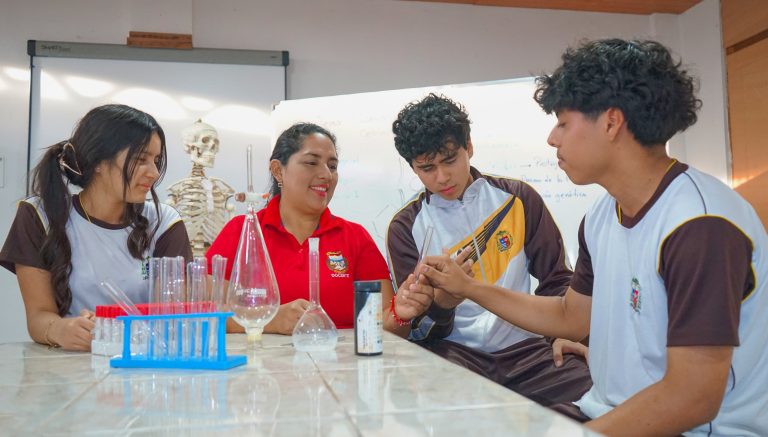
During my first few weeks back on the islands, I attended one of the teacher training sessions, which now take place locally on each island throughout the school year. These sessions offer teachers professional development and provide a network of supportive, accomplished, and collaborative peers. In these gatherings, teachers confidently discussed creative lesson planning, innovative learning strategies, and project-based learning. They also engaged in constructive discussions about how the education system could evolve to better incorporate sustainability education in line with the new Galapagos curriculum and the community’s environmental values. This shift in the education system and student awareness was a testament to the progress made in just a few years, and it reinforced the positive ripple effects of the teacher training program and broader efforts to promote sustainability education.
The commitment to evolving education didn’t stop with the teachers. During my fieldwork, I worked with 5th-grade students (ages 9-10) on Santa Cruz and San Cristobal islands, and I was amazed by their enthusiasm and knowledge. These young students were not only well-versed in Local Ecological Knowledge (LEK) and the impact of human activity on local ecosystems, but they also understood local and some global environmental challenges. They demonstrated a nascent sense of environmental activism, driven by Place Attachment (PA) to and a sense of stewardship for the Galapagos and fueled by a range of impactful learning experiences about their environment. These findings are unfolding as part of my ongoing analysis of all the data that students allowed me to gather in 2022 and will continue to provide insights into what seems to be a natural spring of passion for the local environment that the education system can use to continue to evolve their implementation of EFS for young students in Galapagos.
I recently joined the advisory team of a new nonprofit, EcoEducate, founded by some of the early leaders of the teacher professional development program in Galapagos. Our goal is to extend lessons learned in Galapagos to other coastal and island locations in Latin America, building a network of education communities that become showcases of Education for Sustainability in action. As in Galapagos, these new efforts will involve teachers, local organizations, parents, and community leaders and potentially drive significant progress toward a more sustainable future, not just in individual regions but across entire countries.
I’m honored and excited to be part of EcoEducate’s work and I look forward to seeing the incredible outcomes that communities will achieve with the support, resources, and programming we can provide.
[1] Huckle, J. (1996). Education for sustainability. Earthscan.
[2] Education for Sustainable Development | UNESCO. UNESCO. (n.d.). https://www.unesco.org/en/sustainable-development/education