In the Galapagos Islands, English is more than just another subject—it’s a lifeline to opportunity. For local youth, having strong English skills can open doors to careers in science, conservation, and tourism — the three sectors that define both the islands’ economy and the future of the islands’ natural resources and biodiversity. Equally important to having solid English skills is a student’s environmental literacy — the knowledge and understanding of environmental issues coupled with the motivation to take positive action. Together, these two skill sets can prepare young people to thrive while protecting the fragile ecosystems of the islands they call home.
That’s where EcoEducate comes in.
Susan Huss-Lederman, Professor Emerita at the University of Wisconsin–Whitewater and EcoEducate’s Director of Eco-PBL, brings years of experience supporting English teachers across Latin America. Her specialty is helping teachers integrate best practices in English instruction with Project-Based Learning (PBL) — an approach where students build knowledge as they carry out projects of their own design focused on real-world problems. In Galapagos, this means students practice their English skills while tackling economic, social, and environmental challenges that directly affect their communities, deepening both language skills and environmental awareness.
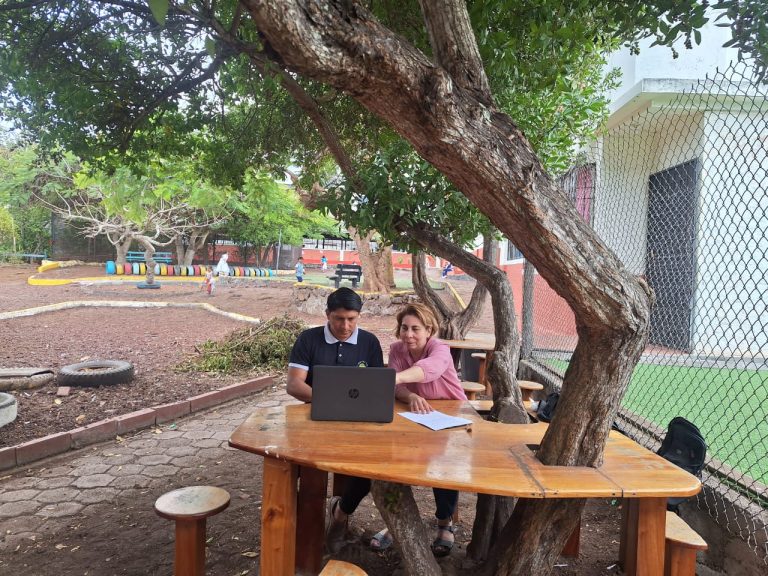
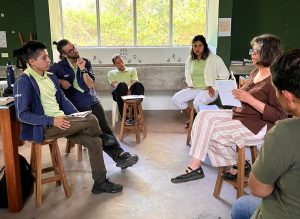
This August, Susan traveled to the Galapagos Islands to expand this work. On Santa Cruz Island, she worked with Fundación Scalesia and its Tomás de Berlanga School (TBS), the only PreK–12 bilingual school in Galapagos, which aspires to model best practices and serve as a demonstration school for the archipelago. From there, she spent a week working with English teachers on the more remote Isabela Island. Each morning, she observed English classes and met with teachers to provide feedback. In the afternoons, she led workshops where teachers practiced
proven strategies to make English learning interactive, engaging, fun, and locally relevant.
Moving forward, Susan will meet online with teachers on both islands once a month to facilitate the exchange of ideas and experiences. She is also forming a team of English-language instructional coaches — teacher-leaders who will guide the professional growth of their peers. Once these coaches are ready, they will lead workshops, observe classrooms, and provide constructive feedback to strengthen teaching practices to better boost their students’ English skills. By building this kind of local capacity and expertise, EcoEducate ensures that upward change continues long after individual training events conclude.
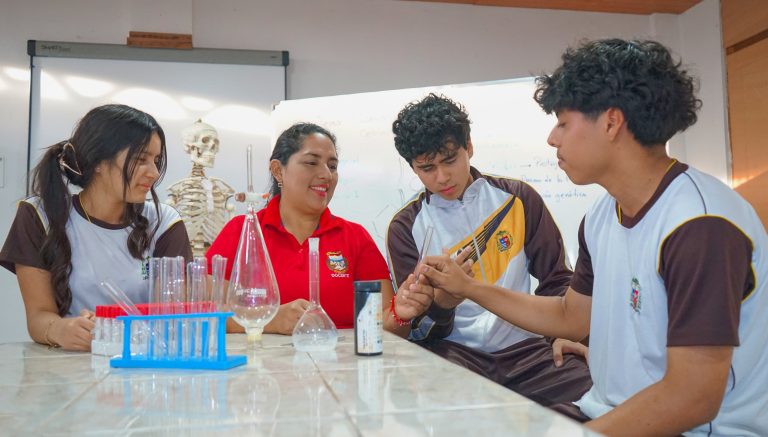
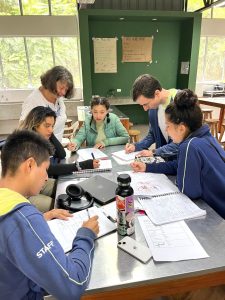
“I always enjoy the innovation that Galapagos English teachers bring to communicating about sustainability. On this visit to the Tomás de Berlanga School, I observed ninth grade science students engaging in a collaborative activity — scientific taxonomy — using a cooperative learning technique, in English, that their teacher, Dina Orellana, had learned during one of our workshops.
On Isabela Island, I saw teacher Nancy Cartagena teach passive voice, an important structure in scientific writing, using Galapagos themes. The true test of language learning is to use the new language in a spontaneous situation. While having supper at a small street-side cafe, I was delighted to hear from a seven-year-old on Isabela, who recognized me from visiting his school. He proudly told me the names of all the endemic species he knew, in English.”
— Susan Huss-Lederman, on her recent work with teachers in the Galapagos Islands
By promoting best practices, investing in teacher-leaders, and connecting English education to conservation and community realities, EcoEducate is helping Galapagos students strengthen their English language skills while also building the environmental literacy they’ll need to shape meaningful futures — for themselves and for their remarkable Islands.