By Heny Ágredo, Director of Education at EcoEducate
At the very heart of our mission here at EcoEducate is the concept of Place-based Education — I’d like to begin with a few stories that illustrate how this concept translates into valuable student learning:
In a rural community located in the foothills of a Colombian mountain range, high school students develop an understanding of the Biodiversity of Mountain Ecosystems through direct engagement with their local environment.
Instead of reading about ecosystems or watching videos, they embark on an exciting field expedition. Equipped with field guides, binoculars, magnifying glasses, notebooks, and cameras, students explore diverse habitats—from dense forests to highland meadows—observing the unique interactions between plants, animals, and their surroundings. They collect data on local species through hands-on activities like insect and bird censuses, monitoring how factors like rainfall, temperature, and seasonal changes impact the ecosystem. Over the course of several months, students track biodiversity shifts, building an understanding of ecological patterns. This authentic, sensory-rich exploration allows students to connect with the environment in meaningful ways, fostering a deeper appreciation for conservation and ecological balance.
In an urban center in Ecuador, middle school students focus on the theme of Urban Transportation and Mobility.
They begin by conducting a walkability audit of their neighborhood, where students assess the accessibility, safety, and efficiency of local sidewalks, bike lanes, and public transportation systems. They collect data on traffic patterns, pollution levels, and pedestrian experiences, using tools like photo journals and surveys. Students then explore alternative transportation solutions by visiting a local bike-share station, interviewing city planners about sustainable transit initiatives, or touring an electric vehicle charging station. They research innovations in urban mobility, such as car-free zones or micro-mobility solutions (e-scooters, shared bikes). As a final project, students design a sustainable transportation plan for their city, proposing new bike lanes, improved bus routes, or pedestrian-friendly spaces. They present their ideas to local government officials or community organizations, advocating for a greener, more connected city.
On a small island in the Pacific, elementary students learn about Traditional Island Knowledge and Modern Sustainability.
Their teacher guides them through a unit beginning with a deep dive into the island’s cultural heritage, exploring how indigenous knowledge of fishing, farming, and weather patterns has shaped the local community. Students interview elders, learn about traditional navigation techniques, and visit cultural sites to understand the island’s history. Next, they explore how modern environmental challenges, like climate change and rising sea levels, are impacting the island. Students conduct field research on erosion, coastal damage, and biodiversity loss. For their final project, students work in groups to propose solutions that blend traditional practices with modern sustainability, such as creating a community-based farm-to-table system or promoting sustainable fishing practices. They present their solutions to the community, fostering a dialogue between the island’s past and future.
These are all examples of Place-Based Education (PBE) — an educational approach that connects students’ learning to their local environment (Smith, 2002). Curricular standards and objectives align with relevant issues in the community, viewed through ecological, cultural, and economic lenses (See Figure 1 below). Beyond engaging in student-centered lessons and activities inside the classroom, students learn through authentic, hands-on experiences outdoors that help them understand the world around them and develop solutions to real-world problems (Smith, 2002). This represents a significant shift in the type of education we want for our students and in the goals that the school system should pursue to advance society.
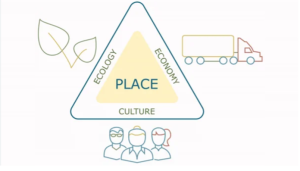
Figure 1. Understanding “place” as the intersection of ecology, economy, and culture (Teton Science Schools).
As a busy educator facing many demands and limitations, you would not be alone if your first reaction to such an approach included:
- “Sounds cool, but I simply don’t have time for this!”
- “I have no idea where I would start!”
- “My institution doesn’t have a budget for this.”
- “I have a very large group of students with behavioral problems.” (Yemini et al., 2023)
Even though Place-based Education is an educational model based on harnessing students’ inquiry about a specific place through related activities and place-based content, it is not necessary for teachers to work alone to design complex logistics or projects. Teachers can take an important first step through communicating with peers, exploring potential collaboration with community members, establishing clear objectives, and, above all, understanding why we want to implement this model (Powers, 2004).
When designing a place-based lesson, we start with the place at the center (Nichols, 2016). This can mean a current community problem, such as the inadequate management of garbage by the residents; a new space in the community, such as a public library, or even the curiosity of our students toward a particular space, such as the history behind a colonial building. From there, we develop our lessons, activities, materials, visits, evaluations, and all other components necessary for an engaging learning experience as seen in Figure 2.

Figure 2. Place-based lesson design
In Place-Based Education, students must play active roles that enlist their spirit of inquiry and natural curiosity as they explore community issues (Vander Ark et al., 2020). When planning, teachers think about activities that give students prominence, such as completing projects that include climate data collection, description and identification of species using field guides, interviews of community members, censuses or inventories of species, and permanent biodiversity monitoring, among others. Remember that in Place-based Education, teachers present students with opportunities to connect their learning with their real lives and the context they inhabit (Smith, 2002).
Over the coming months, we will share a series of posts in which we will explore the topic of Place-based Education and other forms of curricular contextualization. We will be hearing from educators who are implementing this kind of education in places like the Galapagos Islands in Ecuador and the Juan Fernandez Archipelago and Mocha Island in Chile. We would also love to hear from you about your experiences and questions!
Feel free to contact us: [email protected]
References
Nichols, J. B., Howson, P. H., Mulrey, B. C., Ackerman, A., & Gately, S. E. (2016). The promise of place: Using Place-based education principles to enhance learning. The International Journal of Pedagogy and Curriculum, 23(2), 27-41. https://doi.org/https://doi.org/10.18848/2327-7963/CGP/v23i02/27-41
Powers, A. L. (2004). An evaluation of four place-based education programs. The Journal of Environmental Education, 35(4), 17-32. https://doi.org/10.3200/JOEE.35.4.17-32
Smith, G. A. (2002). Place-based education: Learning to be where we are. Phi Delta Kappan, 83(8), 584-594. https://doi.org/10.1177/003172170208300806
Teton Science Schools. (n.d.). Place-based education. Teton Science Schools. Retrieved December 13, 2024, from https://www.tetonscience.org/about/place-based-education/
Vander Ark, T, Liebtag, E., & McClennen, N. (2020). The power of Place: Authentic learning through place-based education. ASCD.
Yemini, M., Engel, L., & Ben Simon, A. (2023). Place-based education – a systematic review of literature. Educational Review, 1-21. https://doi.org/10.1080/00131911.2023.2177260